
Overview
The study of a foreign language, literature, and culture like Spanish traditionally has been one of the central components of an undergraduate education in the humanities.
Today there is an added practical dimension to this. With economic and cultural globalization, our links as a nation with Spain and Latin America have become much closer. At the same time, Spanish is not only a foreign language for us; it has become—much like French in Canada—a de facto second language in the United States.

With a Hispanic population of just over fifty million (2010), the United States itself is the third largest country of the Spanish-speaking world. Spanish is the fastest growing field in the humanities today (more than 50 percent of enrollments in language classes in the United States are in Spanish). As a result, there is a growing demand for persons trained in Spanish (and also Portuguese) in many fields, especially education, where there is a shortage of new teachers of Spanish language and literature.
The Department of Hispanic Languages and Literatures is especially noted for its faculty strengths in the area of Latin American literature and culture, including Brazil, but we also cover Spain and U.S. Latino culture and areas of Hispanic linguistics.
The department works in close cooperation with the University of Pittsburgh Center for Latin American Studies (CLAS), and many students choose as a related area the CLAS undergraduate or graduate certificate program. We also have strong ties to the Film Studies Program, West European Studies, and the Graduate Program in Cultural Studies.
Events
***********
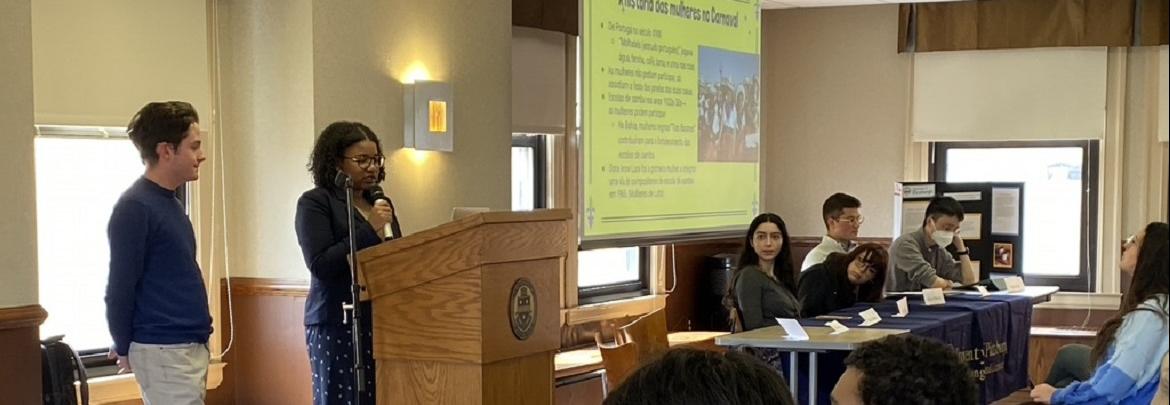
9th Undergraduate Research Symposium
on Latin America and the Caribbean.
Greensburg Campus, University of Pittsburgh, April 5, 2013
Present your research with other undergraduate students on any topic related to Latin American Studies in literature, culture, linguistics, art, or professional academic disciplines.
The IX Undergraduate Research Symposium on Latin America and the Caribbean will be held on April 5, 2013. Students will have about 15 minutes to make their presentations. They will have access to power point equipment, or use posters if they choose. Presentations can be made in Spanish, Portuguese or English. Submit a 150-word abstract to Dr. Alicia Covarrubias at upgurs@pitt.edu by March 15, 2013
For information about previous symposia, click here
**********
Los holandeses atacan desde afuera, los gobernantes nos roban desde adentro’: Informe de Lugo y Dávila a Felipe IV en defensa y conservación de la plaza de la isla de Puerto Rico
by Carmen Rita Rabell (University of Puerto Rico)
Conference will be in Spanish, but questions can also be answered in English
Monday, April 1, 2013, 302 Cathedral of Learning
3:00-5:00 p.m.
Carmen Rita Rabell is Professor in the Department of Comparative Literature at the University of Puerto Rico. Professor Rabel received her PhD and MA in Romance languages (Stony Brook, SUNY (1990) and her PhD, MPhil in Comparative Literature (2000) at Columbia University. Former Assistant Professor at the University of Pittsburgh (1990-97), and Visiting Professor at the University of Cincinatti. She has published, among others, Rewriting the Italian Novella in Counter-Reformation Spain (2003), Periodismo y ficción en ‘Crónica de una muerte anunciada’, (1994) y Lope de Vega: el arte nuevo de hacer “novellas” (1992). In 2012 she published her memoir Crónicas para matar el cáncer.
***********
Sexo en Saer: el arte del fantasma
by Dardo Scavino (Université de Versailles)
presented in Spanish
Monday, March 25, 2013, 206 Cathedral of Learning
4:00
Dardo Scavino is the author of numerous books on Latin American philosophy, literature and history, including Barcos sobre la pampa: Las formas de la guerra en Sarmiento (1993), La filosofía actual: Pensar sin certezas (Paidós, 1999), La era de la desolación: ética y moral en la Argentina de fin de siglo (1999), Recherches sur la littérature policière en Argentine (1999), Saer y los nombres (2004), El señor, el amante y el poeta: notas sobre la perennidad de la metafísica (2009) and Narraciones de la independencia: Arqueología de un fervor contradictorio (2010). He is also the co-author (with Miguel Benasayag) of Le pari amoureux (1995) and Pour una nouvelle radicalité (1997).
***********
La novela del personaje y la novela del narrador: Sobre Lo imborrable y El entenadode Juan José Saer
by Nicolás Lucero (University of Georgia)
presented in Spanish
Monday, March 4, 2013, 302 Cathedral of Learning
4:00
Nicolás Lucero is the author of the forthcoming book La pasión de la distancia: Saer y la estética de la novela (Buenos Aires: Santiago Arcos Editor, 2013) and of numerous articles on nineteenth and twentieth century Latin American literature.
***********
Feminism and the Ruses of Coloniality
Friday, March 1, 2013. Humanities Center conference room (602 CL).
Event schedule:
1:30-2:00 WELCOME
2:00-3:00 SESSION I “Mestizaje and ‘Alien’ Identity: Gloria Anzaldúa on Immigration” Natalie Cisneros, Assistant Professor of Philosophy, Allegheny College
Respondent: Elizabeth Monasterios (Hispanic Languages and Literatures)
3:10-4:10 SESSION II “Feminismo comunitario es feminismo revolucionario” Julieta Paredes (Mujeres Creando Comunidad)
Respondent: Armando García (Hispanic Languages and Literatures)
4:30-5:30 SESSION III Roundtable discussion on “Feminism & the Ruses of Coloniality,” led by Armando García (Hispanic Languages and Literatures)
***********